

With the article “Achieving continuous improvement through Kanban” I kicked-off a series of blog posts to explain my experience of how you might succeed with seeding a culture of continuous improvement in your organization. As you probably know, I am totally no fan of recipes and thus, it might come with no surprise that I won’t present you the best practices and if you only follow them you’ll be successful. Stop dreaming!
However, I do think there is one very important practice, which it’s worth knowing if you are on the way to create a culture of continuous improvement. In fact, this practice is so important it can either propel you forward to great success or become one of your most difficult struggles that keep you from optimal productivity. Identifying stakeholders and getting them to work for you as opposed to against you is one of your potential greatest assets in achieving continuous improvement. But, here’s the big question. How do you get them to work for you?
A good starting point is to find out your stakeholders – visualize them and their relationships. Stakeholders are anyone who has a vested interest in the outcome of your change initiative. Internal stakeholders are those who are directly affected by the initiative – basically everybody who’s working with the kanban system. However, what about those who may be indirectly affected by any changes made to your systems or procedures? These are your external stakeholders who may not be directly involved with your day to day operations or decisions, yet still have a particular interest in the outcome of any decisions you make.
By identifying both parties and bringing them in to your problem-solution equation can be extremely beneficial to any organization and create a win-win for everyone.
Create a map of stakeholders
Here is a 5-step process for identifying and targeting key stakeholders on your quest for continuous improvement.
Step 1: Brainstorm your stakeholders.
Step 2
Start making a list of key stakeholders. Remember they can be both internal and external stakeholders. Think of departments like sales, operations, business development, customers, quality assurance, suppliers, works council, etc.
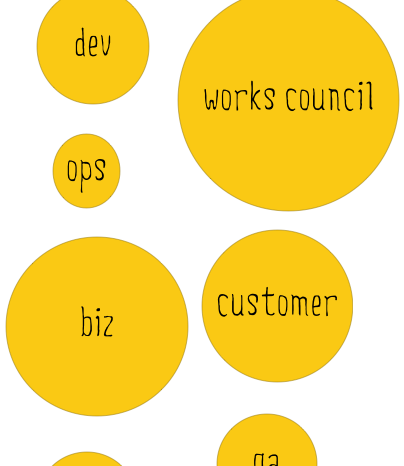
Step 2:* Visualize the influence and power of each stakeholder. ***Now that you have a comprehensive list of stakeholders, use e.g. differently sized cards to show what level of influence to your Kanban initiative each stakeholder has. Make larger cards for a stronger influence and smaller cards to represent a smaller influence. Your cards will now look something like the graphic to the right.
Step 3:** *Visualize the buy-in to your Kanban initiative. *
Step 3
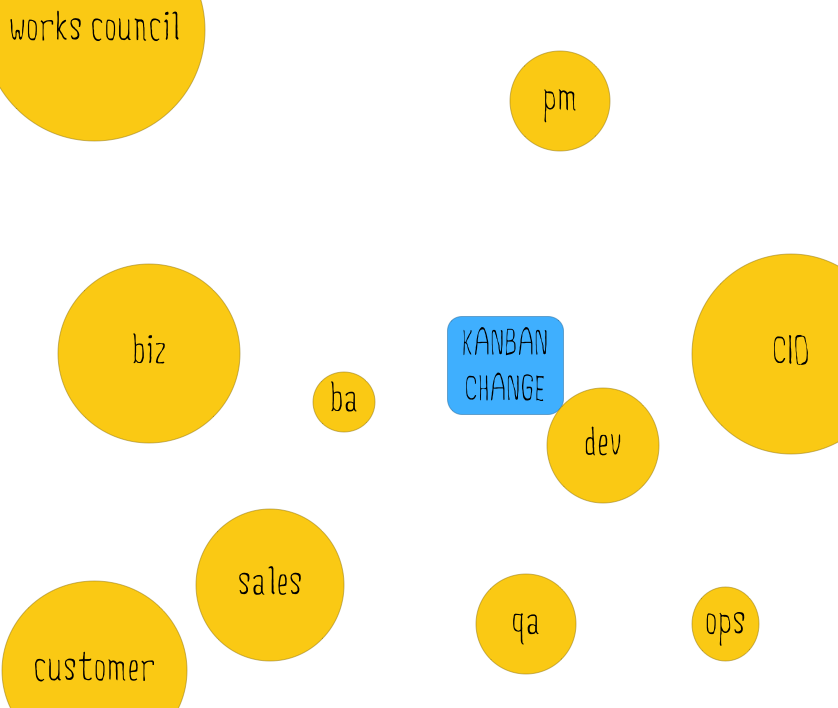
You now have an opportunity to visually represent where each of these influencers are with respect to buying in to your initiative. Will they be difficult to reach or convince or very easy? Take a look at the graphic “Step 3” which shows your Kanban change initiative shown as the center of gravity. Place each influencer card in a spatial relationship with how close or how far they are from accepting your change initiative. This will help you see two important things: (1) how powerful each influencer is, (2) how positive each is relative to your change initiative.
Step 4: *Visualize the frequency of these relationships. *
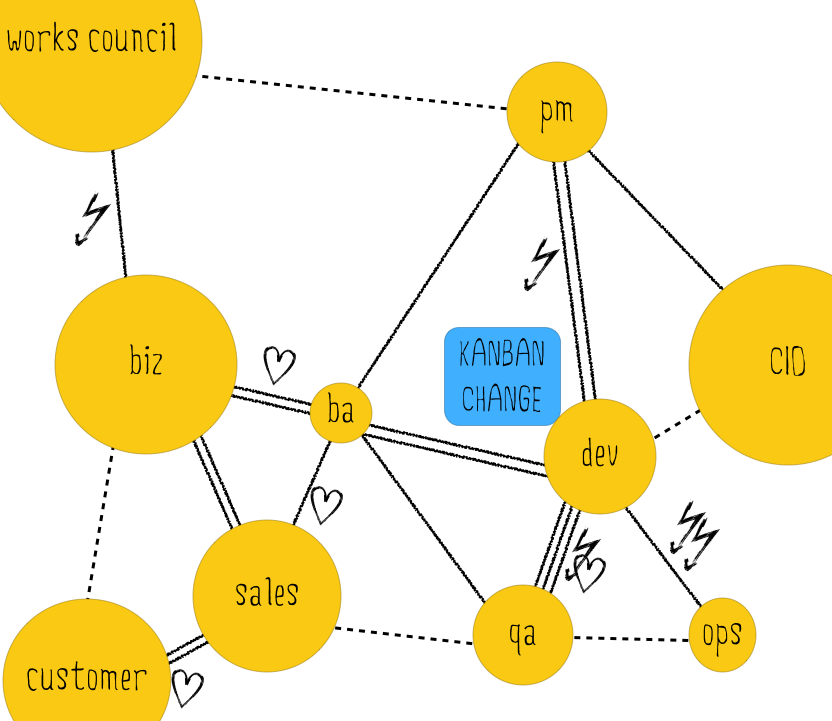
Begin drawing lines between stakeholders to show what the real life relationships look like. Use solid lines to represent good relationships between two stakeholders. A dotted line means a relationship is in place, but perhaps not very strong or the communication may be weak or infrequent. Use two or three parallel lines to show a healthy, strong relationship between two stakeholders. In the end, you get a graphic representation showing strength, power of influence and the nature of each relationship which will bring you closer to identifying key stakeholders.
Step 5: *Visualize the quality of these relationships. *
Step 5
Are these stakeholders friendly? Adversarial? Love-hate relationship? What we are trying to understand is how these groups will relate to the change you will be proposing. This helps the Kanban change team (see “Achieving continuous improvement through Kanban”) to fully visualize and assess what they are up against as well as help prioritize whom they should try to target first. To illustrate the nature of each relationship, try drawing e.g. a heart to represent a strong accepting relationship or a positive alliance. Draw a thunderbolt for an adversarial or difficult relationship. Your graphical representation may look similar to the graphic shown.
You see that’s no rocket science. However, it’s a perfect tool to define a strategy of how to win over your stakeholders for you Kanban change initiative. And remember that a change team developed this stakeholder map – so the chances are quite high that it’s pretty close to reality.
Uncover dissatisfactions

Once you have identified key stakeholders, you are ready to approach them to bring them to your change initiative. A good way is to address some of their dissatisfactions with the kanban system. However, in order to do so, you’ll have to figure out what your stakeholders’ dissatisfactions a** re. There are different ways to do so: mind reading or gazing at the crystal ball are not very reliable methods. I have a lot of success using the world famous A.S.K. method – go to the people and ask**! Try it! It really works… 😉
You can conduct one on one interviews or group interviews depending on the method that works best for you. Your stakeholder map will help you figure out the best way of how to approach your stakeholders. When asking about dissatisfactions, be sure to ask for a ranked list of dissatisfactions so you understand their order of priorities. Make sure your stakeholder understand that your effort is not about introducing Kanban. No! Nobody needs Kanban on its own. Kanban is a means to its end. The real goal is to improve work – solve dissatisfactions of your stakeholders.
One of the greatest advantages of going through this process is that you are no longer working on assumptions, but the reality of who holds the most power, where each relationship is in its present state and where to go on a step by step basis to get closer to the solutions to your problems. This removes the guesswork and allows you the most direct, honest route for the fastest resolution.
The comment function is currently not available. Send us your comment via the Contact form.