
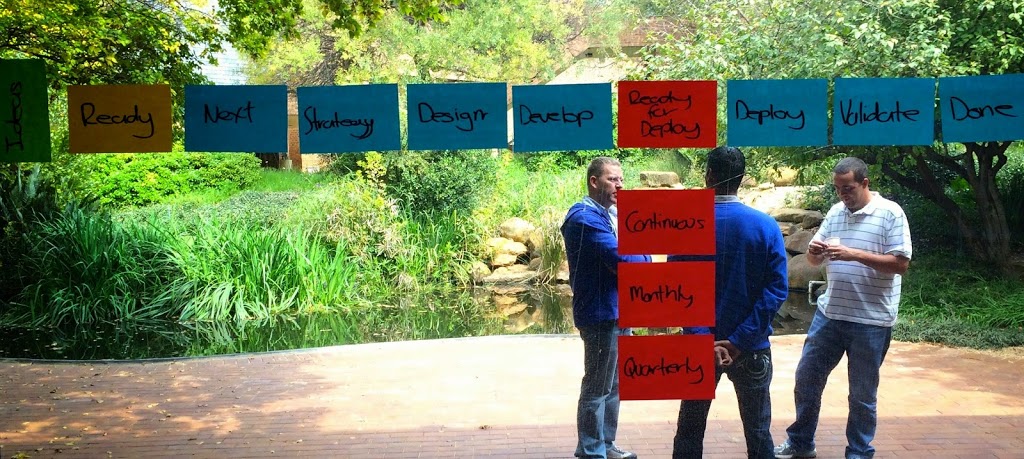
Again and again I am confronted with the problem of having to explain to people that Kanban is not a team-centered method but a flow-based approach. But where is the difference and why is it important to understand the difference?** In flow-based development the focus is not on optimizing the team, i.e. one sees “high performing teams” definitively not as a goal of improvement work, because the danger exists that through this the entire system is sub-optimized. In the flow-based way of thinking, it is a matter of optimizing the value creation chain resp. the workflow and accordingly it is a matter of (more) global optimization. See also the article “Why Kanban Flight Levels” in this regard.
Let’s order a couple of books
But how can one imagine that the value chain is optimized and not the individual team achievements? If, for example, you order a few books from your trusted bookseller on the Internet, from the perspective of the bookseller a value for the customer must be created:
-
First all necessary books are organized. They are fetched from storage or books not in storage are ordered from the publishing house.
-
Then the books are packed into a package.
-
In the next step, an invoice is created.
-
Subsequently the book is ready for delivery and can be handed over to the package service.
-
When the customer has paid the invoice, the ordering process is completed for the bookseller.
A greatly simplified representation of these steps as a work flow could look like this:
Organize books –> Pack books –> Issue invoice –> Deliver package –> Wait for payment –> End of story
These steps could just as well be a first draft of columns of a possible Kanban board. What did we do? We freed ourselves from the organizational structure and placed the customer in the focus of our attention.** “What do we require in order to generate a value with the customer?” was the central question. The customer wants books – we made it explicit how we are fulfilling this wish. The flow board is complete!
The organizational structure comes later
After we know, how we generate value, we can ask ourselves the question, whom we require for this. Those are probable people who are part of teams, groups, departments or similar organizational units. In the step “organize books” of the example above, possibly an entire department is in charge of the book warehouse. These are colleagues who get books out of the warehouse, who order new books from the publishers when required and pack these neatly. Invoicing and payment tracking is the job of a completely different department – the finance department. This means that in order to generate value for the customer different participants are required from different organizational units in several areas of the value chain. And it is precisely this kind of interaction of those involved that one wishes to optimize using a flow-based approach.
First it must be clarified how the business actually generates value for its customers, and in a second step we take a look at the involved persons/teams/departments/etc.
If a lot of people are involved in the workflow which is to be optimized and a company cannot imagine “Kanbanizing” the whole workflow, one can use the Flight levels model as an aid to start with less complexity. Nevertheless the fact is: Kanban focuses on value generation and not on the local optimization of teams!
The comment function is currently not available. Send us your comment via the Contact form.